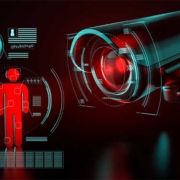
Gavin McCartney from Corps Monitoring sparks the debate around Artificial Intelligence in CCTV and Alarm Monitoring
This article was provided to, and published by, IFSEC Global. You can read the article here.
In this article, Gavin McCartney explores the debate around AI and whether it has the capacity to change the landscape for CCTV monitoring as we know it.
A brief history of CCTV
Despite their introduction in Germany in 1940, the first CCTV cameras did not appear in the UK until 1960. Back then, if you were asked, “Do you think that Camera monitoring (CCTV) will ever replace the need to have a security officer on your site?” or “Could Camera monitoring (CCTV) be used to reduce the hours the security officer is required to work on your site” the answer would have most likely have been ‘no’.
The idea of remotely monitoring CCTV cameras was a thing of science fiction, especially when considering dial up internet had not yet been invented or theorised. Now, companies and individuals are seeing the benefits of remotely monitored security systems as part of everyday life, be it an individual’s video doorbell or a company’s fully monitored security system. This is, in some situations, resulting in the requirement for local security officers to cover sites being reduced.
The Introduction of ARCs
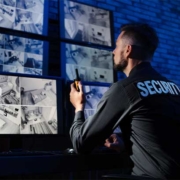
Increased connectivity has allowed for the creation of the Alarm Receiving Centre (ARC), but what is an ARC? An ARC is a manned control room where alerts are received from client systems on their monitored sites. These alerts are usually received on a front-end monitoring platform that can receive alerts from multiple disparate systems (systems that do not necessarily integrate with each other).
Typically for a CCTV alert, an alarm is generated on site by movement. The alert is then sent to the ARC and an operator answers the alarm which shows pre/post images of the movement captured on site, alongside the live cameras of what is happening now. The alarm image allows the operator to make a judgement as to whether the alarm is genuine or false and can then determine the appropriate escalation/action. Their actions will follow the predetermined management criteria for the incident type identified.
One of the biggest advances in both CCTV and remote monitoring in recent years is the development of Artificial intelligence (AI). Zaman et al (2018) described AI as a ‘…computer program[s] [that can] ‘‘watch,’’ ‘‘identify,’’ and ‘‘understand’’ … clips automatically and efficiently utilizing an existing video infrastructure’. In short, AI is a technology that enables a machine to carry out tasks like a human being.
AI and Machine Learning
AI has developed to now include, in many instances, the capability of Machine Learning (ML). El Naqa & Murphy (2015) explains ML as “…an evolving branch of computational algorithms that are designed to emulate human intelligence by learning…”, whilst Haeniein & Kaplan (2019) define AI with ML as “a system’s ability to interpret external data correctly, to learn from such data, and to use those learnings to achieve specific goals and tasks through flexible adaptation.”.
AI with ML allows the system to automatically learn from the management of past data without the need to be reprogrammed. In relation to ARCs, this could take the form of the system learning from alarm images received and identifying what is normal from a camera view, allowing it to then identify what is abnormal – e.g. if there is an alarm constantly being received where a branch is moving in the wind, after several times of the machine receiving this alert and it being cancelled, it will quickly learn that this is nothing to be concerned about and to disregard the event as false. If, however, in the same image, a person comes in to shot, this would be regarded as true, and the alarm would reach the control room for an operator to manage.
There are currently remote monitoring companies utilising AI with ML via third party alarm filtering software, meaning that regardless of the alerts being sent from the CCTV system on site when the alert is received at the ARC it is run through the alarm filtering software and this determines if the alarm is genuine or false prior to presenting to an operator.
Will alarm filtering software remove the need for human interaction?
The aim of utilising the alarm filtering software is to reduce the workload on their monitoring operation, allowing their staff to manage fewer “nuisance” alerts and focus more on genuine alarms. This is hugely beneficial, but the continuation of this process raises several questions, including:
- Will it reach a point where the people managing this process become obsolete and the requirement for CCTV Operators reduce significantly?
- Has the necessity for human operators already begun to decrease in some areas?
- Will there be a point that the companies only employ a person for specific tasks (e.g. anomaly checking and managing live incidents), operating without the general distractions in a busy ARC?
The more connections put through the AI, the better it becomes at recognising the differences between false alarms (e.g. wildlife and foliage) and a genuine security threat being identified. At present AI is not 100% accurate all the time, and false alarms still get through and/or occasional genuine alarms are deemed as false. However, the number of errors is decreasing year on year.
There is an argument that an operator would be required to differentiate between a person that poses no threat and a genuine intruder, however, will AI eventually get that smart it could differentiate between normal and abnormal behaviour, and effectively do this task without a person being involved?
This may be unrealistic with current technology, however, the advance in technology is not slowing down and AI will not stop learning. It is realistic to predict there may become a point a person isn’t required for this task at all, and the system will do the confirmation with a great deal of accuracy and, potentially, be more accurate than if a person was doing the task.
Aside from AI, automation is already being utilised in the remote monitoring industry via the front-end platforms/alarm handling software. Several functions can be pre-determined, including, but not limited to; audio warnings being issued by the system, contacting keyholders, engaging the police (with the introduction of ECHO), sending of fault alert emails, and reports can also be sent automatically too. All the above were, at some point, manual tasks.
The purpose of noting automation is that the foundation in which a CCTV alarm could be reported should the AI determine the alarm as a threat is already being built most of which has been already.
The question then becomes “will there become a point where the standard of your CCTV system on site doesn’t matter as long as the camera is of relatively good quality for evidential purposes” as the AI will exist within the system, not the device. The system won’t discriminate between a high end premium system or a lower end value system. It won’t require the camera to have its own analytics (including line crossing, PIR detection or video motion detection). So, if a person goes on your monitored site, regardless of your system sending 3 or 3000 false alarms per night, that will be the only alarm actioned.
There are a few questions this technology raises, including:
- Should all remotely monitored CCTV systems eventually be run through AI?
- What would be the environmental impact of the servers being utilised to process and learn this information if all systems were monitored in this method?
- Where do you see the future of AI in remote monitoring?
- Are we supporting a culture where less staff is the aim to reduce overhead (Tesco with self-scanners)?
- Are we going to lose that personal touch for automation?
- Will you even care about not speaking to someone if the system is highly accurate and more cost effective?
- If you do care about a person being involved do you still have full manning of security officers on your site with no electronic security solutions?
To conclude, the people of 1960 couldn’t have realised the extent of benefits from remotely monitored security systems that we are now seeing. The benefit of this approach includes that, after the initial CCTV investment, and despite the system being a depreciating asset, it still naturally reduces corporate overheads.
I now ask the people of 2022 “will AI eventually reduce the need for alarm receiving centres?” and “will we reach a point in time for our security services to be taken care of by a machine?”. I guess time will tell.
Corps Monitoring is a division of Corps Security – the UK’s longest running security company. Corps Monitoring offer a range of technology solutions including CCTV Monitoring Services, CCTV Sensor Activated Monitoring, CCTV Live Surveillance, Fire Alarm Monitoring, Intruder Alarm Monitoring, Personal Protection Services, Key Holding, Call Centre Monitoring, Lone Worker Monitoring and more.